Tuesday, 24 November 2015

WHAT IS THE FUNCTION OF DIRECTIONAL CONTROL VALVE?

To change the direction of airflow to and from the cylinder, we use a directional control valve. The moving part in a directional control valve will connect and disconnect internal flow passages within the valve body. This action results in a control of airflow direction.. The typical directional control valve consists of a valve body with four internal flow passages within the valve body and a sliding spool. Shifting the spool alternately connects a cylinder port to supply pressure or the exhaust port. With the spool in the position where the supply pressure is connected to port A and port B is connected to the exhaust port, the cylinder will extend. Then, with the spool in the other extreme position, supply pressure is connected to port B and port A is connected to the exhaust port, now the cylinder retracts. With a directional control valve in a circuit, the cylinder's piston rod can be extended or retracted and work performed


WHAT ARE THE TYPE OF PNEUMATIC CYLINDER USED IN INDUSTRIES?

The three pneumatic cylinders we discuss below are:
  • Single-acting cylinders
  • Double-acting cylinders
  • Telescoping cylinders

Single-acting cylinders (SAC) use pressure that forms from compacted air. In majority of cases, the extension SAC cylinders have is very limited due to the amount of space the compacted spring takes.
Double-acting cylinders (DAC) use air pressure in order to retract strokes and move in range. Two parts make up this cylinder, both of which let the air in. One is for outstroke and the other, in-stroke.

Telescoping cylinders, also known as telescopic cylinders come in single-acting and double-acting modes. Their designs allow for much longer strokes and tend to be reserved for uses where the piston has to face minimal side loading.

PNEUMATIC SYSTEM MEANS WHAT ?


Pneumatic systems 


            A pneumatic system is a system that uses compressed air to transmit and control energy. Pneumatic systems are used in controlling train doors, automatic production lines, mechanical clamps, etc.A pneumatic system controlled through manual or automatic solenoid valves is selected when it provides a lower cost, more flexible, or safer alternative to electric motors and actuators.             

                                         CLICK HERE FOR MORE DETAILS  

Sunday, 22 November 2015

WHAT ARE THE SPECIFICATION IS TO BE CONSIDER WHILE SELECTING A CYLINDER?

The specifications that need to be considered while purchasing a hydraulic cylinder are:


•  Bore DiameterIt is the diameter of the cylinder bore.

•  Maximum operating pressure: The maximum working pressure a cylinder can carry is known as maximum operating pressure.

•  Rod Diameter: It is the diameter of the piston or the rod that are used in hydraulic cylinders.

•  Stroke: The distance traveled by a piston in a hydraulic cylinder is known as stroke. The length of a stroke could be several feet, or a fraction of an inch.

•  Type Of Cylinder: The different types of cylinders are tie-rod cylinder, ram cylinder and welded cylinder.

Tie-rod cylinder: These types of hydraulic cylinders make use of a single or multiple tie-rods to provide extra stability to the cylinder.   The tie-rods are mostly installed on the exterior diameter of the cylinder. The tie-rods carry most of the load in this type of hydraulic cylinder.

Welded cylinder: There are heavy-duty welded cylinders used to balance the cylinder. The welded cylinders are smooth hydraulic cylinders.

Ram cylinders: As the name suggests, this cylinders act as a ram.   The cross-section of the moving components is half of the cross-section area of the piston rod.   These hydraulic ram cylinders are not used to push and are mostly used to pull. The ram cylinder is a hydraulic cylinder that is used in applications of high pressure.

                                            CLICK HERE FOR MORE DETAILS

WHAT ARE THE COMPONENTS USED IN HYDRAULIC SYSTEM?


The various parts are the cylinder bottom, cylinder bottom connection cylinder barrel, and cylinder head. It also consists of the piston, piston rod, and the piston rod connection. And some of the hydraulic cylinders may comprise of the feet. These are used to mount the barrels.
The cylinder barrel is a thick tube that has to be machined from the inside. The interior of the barrel is honed or ground and in some cases both. The cylinder barrel and the bottom of the cylinder are welded together in most of the hydraulic cylinders.
This welding of the bottom of the cylinder to the barrel can damage the interior of the barrel. Hence, it is preferred to have the two screwed together. This type of connection will be helpful during repairs or maintenance of the cylinder barrel. On the other hand, the barrel is connected to the cylinder head with a lock.
There is a simple lock system used for a simple cylinder. In most of the hydraulic cylinders the flanged or screwed connections are used. The best type of connections and most expensive connections are the flanged connections. It is considered to be the best type of connection because before machining a flange is welded onto the tube.
The other positive aspects are that the flange is always bolted and can be removed easily when required. The disconnection process as well as the alignment process while mounting is much tougher for the bigger hydraulic cylinders. This problem in particular arises where the screw size is between 300 mm to 600 mm.
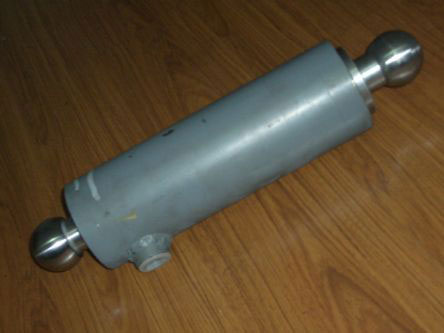
There should be no bending moments implied on the hydraulic cylinder as they are applied in expansion and retraction actions. The single clevis connection with a ball bearing is considered to be the most appropriate connection, as all the above-mentioned problems do not arise.
                                     FOR MORE DETAIL CLICK HERE

HOW THE CYLINDER IS CLASSIFIED BASED ON ITS SPECIFICATION?


These cylinders are also known as Ram cylinders. These types of hydraulic cylinders are placed in an upright position. This is done so that once the supply of the fluid is stopped, the weight on the cylinder will make it return to its original position. The cylinders used in automobile service centers are a good example of the plunger cylinders.


Telescopic cylinders are also known as multistage hydraulic cylinders. These cylinders have at the most six stages. These are specially used in applications where there is less area. Telescopic cylinders can either be single action or double action. The stroke of these cylinders is long and is used in applications such as cranes and forklifts, etc.


The cable cylinders can either be hydraulic or pneumatic powered cylinders that are of the double acting type. These cylinders have long strokes and produce moderate force. The cable cylinders can be operated in limited space.


Diaphragm cylinders are of two types i.e. flat diaphragm and rolling diaphragm. These cylinders have zero leak around the piston.


                                                   CLICK HERE FOR MORE DETAILS

HOW THE HYDRAULIC CYLINDER CLASSIFIED BASED ON ITS FUNCTION?

In single acting cylinders the fluid is pressurized from only one side of the cylinder during both the expansion as well as the retraction process. A spring or an external load is used to return the cylinder top to its original position i.e. when pressure of the fluid is cut off.

In the double acting cylinders, the pressure from the fluid is applied in both the directions. Single cylinders that consist of springs are not used in large stroke applications because there are inherent mechanical problems associated with the spring. The double acting rods could be of two types

•  Single rod ended