Sunday, 22 November 2015

WHAT IS THE BASIC FUNCTION OF PNEUMATIC CYLINDERS ?

The hydraulic pressure in these cylinders is in the form of hydraulic fuels that are stored under pressure in these cylinders. The energy stored in these oils is converted into motion. In a complete hydraulic system, a hydraulic motor consists of one or more hydraulic cylinders. A pump regulates the oil-flow in the hydraulic system. The pump is a part of the generator of a hydraulic system. The hydraulic cylinders initiate the pressure of the oil, which cannot be more than that required by the load. A hydraulic cylinder consists of a cylindrical barrel, piston, and a piston rod. The piston that is placed within the barrel is connected to the piston rod. The cylinder bottom, and the cylinder head, closes the bottom and the head of the barrel respectively. The cylinder head is the side from where the piston rod exits the cylinder. The cylinder bottom and the piston rod are mounted with mounting brackets or clevises. The piston in the hydraulic cylinder consists of sliding rings and seals. The piston rod chamber and the bottom chamber are the two chambers within the cylinder. 
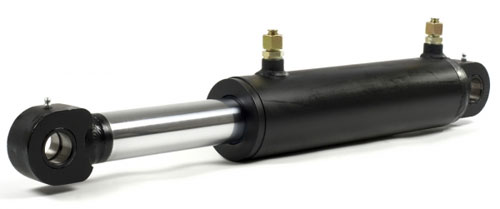

The piston rod starts moving outwards, as the hydraulic fluid is pumped into the bottom side of the hydraulic cylinder. In the reverse process, the hydraulic fluid is pushed back into the reservoir by the piston. The pressure in the cylinder is the ratio of unit force per unit piston area. The pressure generated in the piston rod chamber is the ratio of the unit load per the difference in the unit piston area and unit piston rod area. This calculation is used when the hydraulic fluid is let into the piston rod chamber as well as the fluid flows smoothly (without pressure) from the piston area to the reservoir. In this way, the expansion and retraction (push and pull) action of the hydraulic cylinder is generated.

    we also design some hydraulic cylinders for projects . 
                   for more detail    CLICK HERE


WHAT ARE ADVANTAGES AND DISADVANTAGES OF HYDRAULIC SYSTEM?

Advantages


  • The hydraulic system uses in compressible fluid which results in higher efficiency.  
  • It delivers consistent power output which is difficult in pneumatic or mechanical drive systems. 
  •  Hydraulic systems employ high density in compressible fluid. Possibility of leakage is less in hydraulic system as compared to that in pneumatic system. The maintenance cost is less. 
  • These systems perform well in hot environment conditions. 


 Disadvantages 

  •  The material of storage tank, piping, cylinder and piston can be corroded with the hydraulic fluid. Therefore one must be careful while selecting materials and hydraulic fluid. 
  •  The structural weight and size of the system is more which makes it unsuitable for the smaller instruments.
  •   The small impurities in the hydraulic fluid can permanently damage the complete system, therefore one should be careful and suitable filter must be installed.
  •   The leakage of hydraulic fluid is also a critical issue and suitable prevention method and seals must be adopted.
  •   The hydraulic fluids, if not disposed properly, can be harmful to the environment.

WHAT ARE THE APPLICATION OF HYDRAULIC SYSTEM?

  The hydraulic systems are mainly used for precise control of larger forces. The main applications of hydraulic system can be classified in five categories:

Industrial: Plastic processing machines, steel making and primary metal extraction applications, automated production lines, machine tool industries, paper industries, loaders, crushes, textile machinates, R & D equipment and robotic systems etc.

Mobile hydraulics: Tractors, irrigation system, earth moving equipment, material handling equipment, commercial vehicles, tunnel boring equipment, rail equipment, building and construction machinery and drilling rigs etc.

Automobiles: It is used in the systems like breaks, shock absorbs, steering system, wind shield, lift and cleaning etc.

Marine applications: It mostly covers ocean going vessels, fishing boats and navel equipment.


Aerospace equipment: There are equipment and systems used for rudder control, landing gear, breaks, flight control and transmission etc. which are used in airplanes, rockets and spaceships.

what is pump ?

pump is a mechanical device which is used to convert electrical 

energy into mechanical energy.a mechanical device using suction 

or pressure to raise or move liquids, compress gases, or force air

 into inflatable objects such as tyres.


Pumps operate by some mechanism and consume energy to

 perform mechanical work by moving the fluid. Pumps operate via 

many energy sources, including manual operation,

 electricity, engines, or wind power, come in many sizes, from 

microscopic for use in medical applications to large industrial 

pumps.
                                for more details    CLICK HERE


WHAT ARE THE DIFFERENT TYPES OF PUMPS USED IN HYDRAULIC SYSTEM?

Hydraulic pumps are manufactured depending on different functional and hydraulic system requirements, such as operating medium, required range of pressure, type of drive, etc. A large range of design principles and configurations exists behind hydraulic pumps. Consequently, not every pump can fully meet all sets of requirements to an optimum degree. Three different types of hydraulic pumps exist:
  • External gear pump
  • Internal gear pump
  • Gear ring pump
  • Screw spindle pump
  • Single chamber vane pump
  • Double chamber vane pump
  • Axial piston pump
  • Radial piston pump

WHAT IS hydraulic system ?

Hydraulic systems can be found today in a wide variety of applications, from small assembly processes to integrated steel and paper mill applications. Hydraulics enable the operator to accomplish significant work (lifting heavy loads, turning a shaft, drilling precision holes, etc.) with a minimum investment in mechanical linkage through the application of Pascal’s law, which states:
“Pressure applied to a confined fluid at any point is transmitted undiminished throughout the fluid in all directions and acts upon every part of the confining vessel at right angles to its interior surfaces and equally upon equal areas.


By applying Pascal’s law and Brahma’s application of it, it is evident that an input force of 100 pounds on 10 square inches will develop a pressure of 10 pounds per square inch throughout the confined vessel. This pressure will support a 1000-pound weight if the area of the weight is 100 square inches.
The principle of Pascal’s law is realized in a hydraulic system by the hydraulic fluid that is used to transmit the energy from one point to another. Because hydraulic fluid is nearly in compressible, it is able to transmit power instantaneously.


      we are also using this principle for making our projects. for more details

Saturday, 21 November 2015

what are major components used in hydraulic system?

The major components that make up a hydraulic system are the reservoir, pump, valve(s) and actuator(s) (motor, cylinder, etc.).
Reservoir

The purpose of the hydraulic reservoir is to hold a volume of fluid, transfer heat from the system, allow solid contaminants to settle and facilitate the release of air and moisture from the fluid.
Pump

The hydraulic pump transmits mechanical energy into hydraulic energy. This is done by the movement of fluid which is the transmission medium. There are several types of hydraulic pumps including gear, vane and piston. All of these pumps have different sub types intended for specific applications such as a bent-axis piston pump or a variable displacement vane pump. All hydraulic pumps work on the same principle, which is to displace fluid volume against a resistant load or pressure.
Valves

Hydraulic valves are used in a system to start, stop and direct fluid flow. Hydraulic valves are made up of poppets or spools and can be actuated by means of pneumatic, hydraulic, electrical, manual or mechanical means.
Actuators

Hydraulic actuators are the end result of Pascal’s law. This is where the hydraulic energy is converted back to mechanical energy. This can be done through use of a hydraulic cylinder which converts hydraulic energy into linear motion and work, or a hydraulic motor which converts hydraulic energy into rotary motion and work. As with hydraulic pumps, hydraulic cylinders and hydraulic motors have several different sub types. each intended for specific design applications.

            we are used some of these components in our projects.for more details